Home EV Charging: Bypassing High-Cost Public Chargers
Domestic EV Charging: Bypassing High-Cost Public Infrastructure
Integrating an electric vehicle into a residential property involves far more than simply bolting a standard charger onto the garage wall. Without deliberate hardware coordination, an EV acts as a massive power draw that can easily disrupt your property's energy balance and force unexpected extra costs when buying power from the grid. When properly engineered alongside a high-capacity solar and battery storage array, your vehicle becomes an integrated component of a highly efficient domestic microgrid.
Think of your EV battery as a massive 60kWh secondary storage tank, and your home electrical system as the plumbing trying to fill it. If you open the valve on your charger wide open at the wrong time of day, you instantly exceed what your solar panels can produce. Your house is then forced to pull the deficit directly from the expensive utility grid, completely destroying your energy savings.
The Economic Realities: Public Charging vs Home Generation
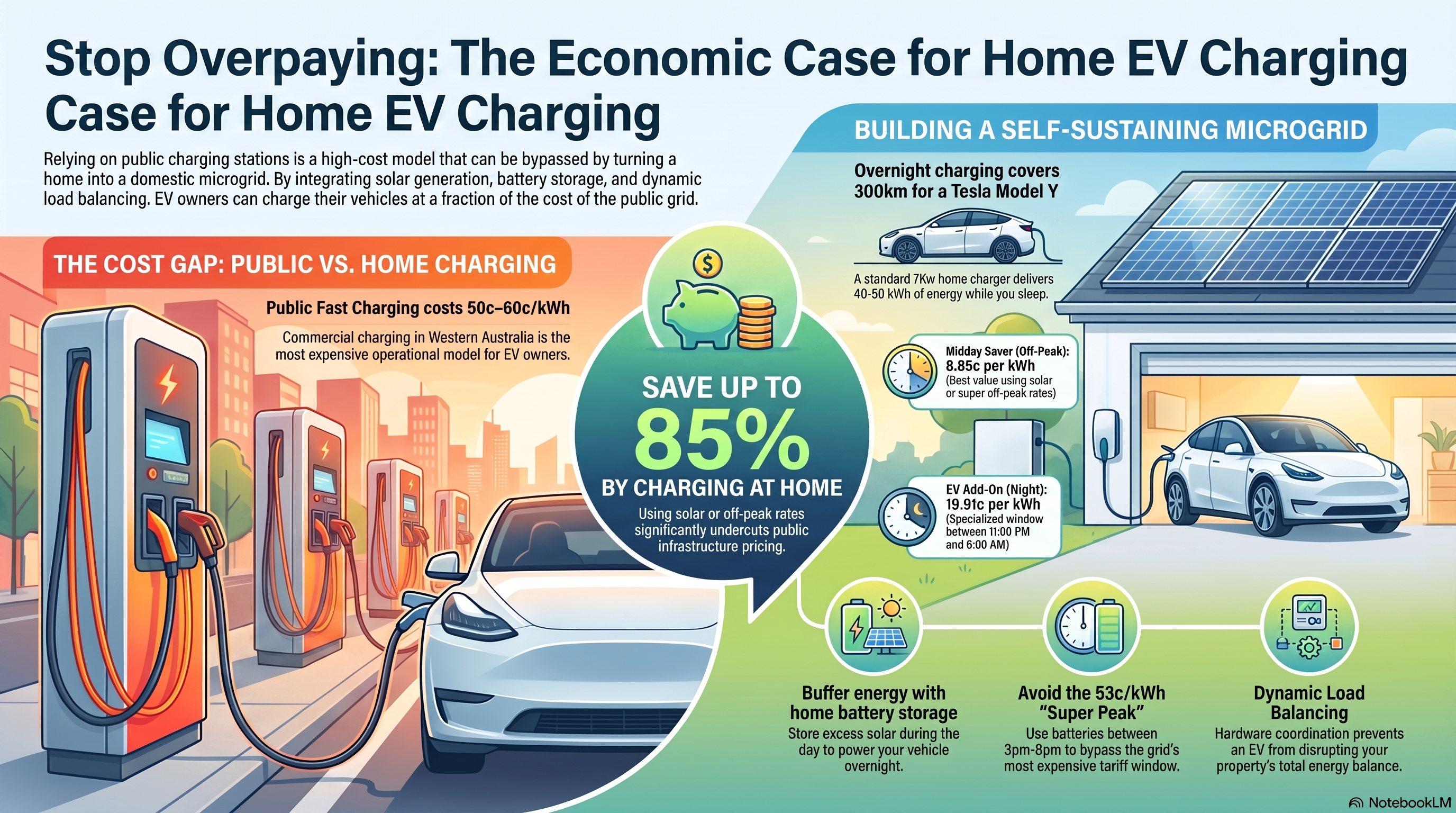
Relying on public rapid-charging stations is an expensive habit. Commercial chargers throughout Western Australia typically cost between 50c and 60c/kWh. When you bring that hardware home and properly manage your power draw, the numbers change completely.
Even without solar, charging at home on the standard Synergy Home Plan A1 flat rate (33.26c/kWh) is significantly cheaper than public stations. To put the hardware capability into real-world outcomes: a standard 7kW single-phase wall charger will deliver 40 to 50kWh of energy to your vehicle while parked overnight for 6 or 7 hours. For a vehicle like a Tesla Model Y or BYD Atto 3, that equates to roughly 300km of real-world driving range ready to go by morning.
Check the Synergy website for up to date tariff information
Charging Option | Cost per kWh | Operational Context |
|---|---|---|
| Public Fast Charging | 50c – 60c/kWh | High-cost commercial chargers throughout WA |
| Midday Saver Off Peak | 8.85c/kWh | Best value using Super Off-Peak rates |
| EV Add-On Tariff (Night) Requires Midday Saver Tarif | 19.91c/kWh | Synergy EV addon window (11:00 PM – 6:00 AM) |
| Home Plan A1 (Flat Rate) | 33.26c/kWh | Standard grid import tariff without load management |
Hardware Coordination & The 3:00 PM Danger Zone
To aggressively cut charging costs, many EV owners migrate to variable time-of-use tariffs like the Synergy Midday Saver, which allows you to charge your vehicle during the day for just 8.85c/kWh using excess rooftop solar.
But here is the critical warning most installers won't tell you about: the trap of variable rate tariffs is the 3:00 PM to 9:00 PM "Super Peak" Danger Zone. During this late afternoon window, grid electricity costs explode to 55.33c/kWh. If you do not have a home battery sized large enough to shield your entire property during this period, the cost of running your ducted air conditioning, oven, and lighting at 6:00 PM will completely wipe out the money you saved charging your EV earlier in the day. A properly sized home battery is an absolute, non-negotiable requirement to survive this tariff structure.
Eliminating the Grid: Leveraging Storage for Overnight EV Charging
The ultimate step in property engineering involves utilizing a dedicated home battery to capture that ultra-cheap 8.85c/kWh daytime solar, and then discharging that stored power directly into your vehicle overnight.
Alternatively, if your home battery capacity needs to be fully reserved for running the house during that expensive 3:00 PM peak, we deploy smart EV chargers with dynamic scheduling. We configure the hardware to block all charging until exactly 11:00 PM, allowing the vehicle to pull power directly from the grid exclusively during the 19.91c/kWh EV Add-On window. This automated coordination completely eliminates high-cost grid imports during charging cycles without you ever having to lift a finger.