Inverter Throughput vs Battery Capacity: Why You Are Still Buying Grid Power
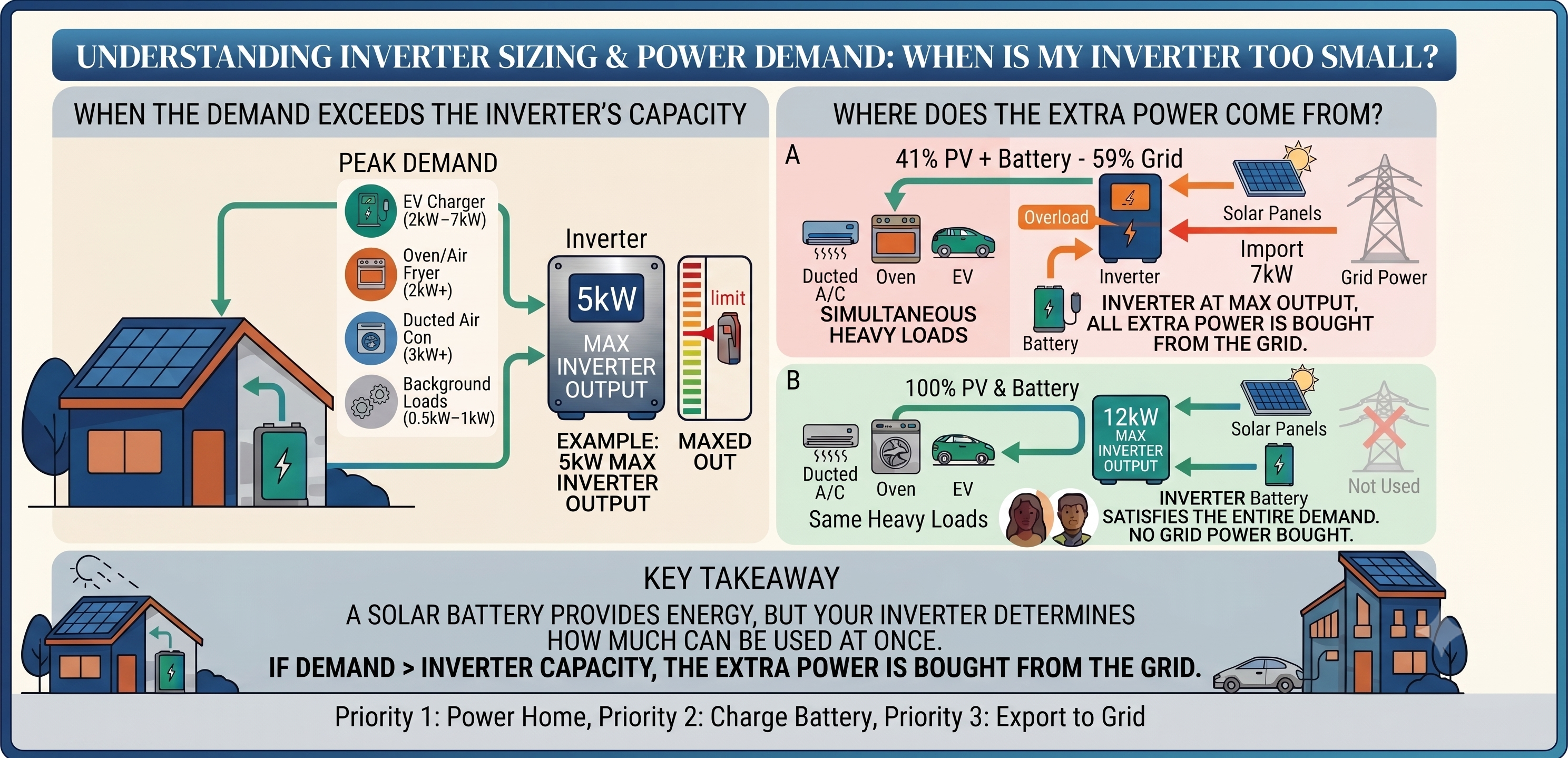
The biggest mistake premium property owners in Perth make right now is buying a massive home battery but pairing it with an undersized inverter. Many people expect complete grid independence, only to check their utility app and find their system pulling expensive power from the grid all evening long. Your battery dictates how much total energy you have stored in reserve, but your inverter strictly dictates the maximum power you can actually push into your house at any single moment. When you mismatch these two pieces of hardware, you create a structural bottleneck that fails to carry the heavy electrical loads of a modern home.
The Water Tank Analogy: kW vs kWh
To understand why this happens, look at your solar and battery setup exactly like household plumbing. Your battery capacity is measured in kilowatt-hours (kWh). This is your water tank—the total volume of energy you have sitting in reserve. Your inverter capacity is measured in kilowatts (kW). This is your hose pipe, which dictates the maximum flow rate of power you can pull out of that tank.
If you have a 15kWh battery tank and you are drawing a steady 5kW of power through your inverter pipe, that battery will last you exactly 3 hours before it runs dry. However, if your simultaneous power draw inside the house demands 8kW, but your inverter is only rated for 5kW, the hardware simply cannot stretch its flow rate. The 3kW deficit is instantly imported from the grid to balance the circuit, regardless of whether your 15kWh battery tank is 100% full.
Perth Load Profiles & The 3:00 PM Danger Zone
Our intense climate and reliance on heavy air conditioning means standard Perth properties regularly overwhelm outdated 5kW inverters. Consider what happens during a typical summer afternoon when multiple appliances run simultaneously:
- Background household electronics draw 0.5kW to 1kW.
- A premium ducted air conditioning system draws 3kW to 8kW or more.
- An oven or induction cooktop draws 2kW to 3kW.
- A standard home EV charger draws up to 7kW.
In this scenario, your peak power draw easily spikes to 10kW or 12kW. If your property relies on a standard 5kW inverter, you are physically capped. The remaining 5kW to 7kW deficit is pulled directly from the Western Power grid.
This bottleneck becomes a financial disaster if you are on a time-of-use tariff like the Synergy Midday Saver. When the clock hits 3:00 PM, you enter the "Super Peak" Danger Zone, where grid electricity explodes to 55.33c/kWh. If your 5kW inverter chokes while you are cooking dinner with the AC running, that 5kW deficit will cost you over $2.75 an hour in unexpected extra costs, destroying your return on investment. To survive this tariff and achieve zero grid import, you need hardware engineered to match your peak load, such as a 10kW or 12kW inverter.
Smart Throttling: Bypassing Single-Phase Grid Limits
For single-phase households across Perth, Western Power generally enforces strict grid allocation limits, often capping single-phase inverter hardware at 10kW. When you add a high-draw electric vehicle charger to a home already running a heavy ducted HVAC system, you hit that 10kW hardware ceiling instantly.
We solve this physical constraint by integrating smart EV chargers that communicate directly with the property's main electrical board. This allows us to throttle the EV charging speed dynamically in real-time. As heavy loads like the oven or air conditioner kick on, the smart charger automatically backs off to keep the total household demand strictly under the 10kW inverter limit. The second those domestic appliances turn off, the charger increases its speed, maximizing your self-consumption without drawing a single expensive watt from the grid.