Synergy Tariff Alignment: Maximizing ROI Through Smart Battery Arbitrage
To maximize the return on investment of a high-end solar and battery system, your physical hardware setup must align directly with time-of-use tariffs. The days of simply slapping panels on a roof and forgetting about them are over. In the current 2026 Western Australian energy market, achieving the fastest payback period requires active tariff arbitrage.
Think of tariff arbitrage like buying construction materials for a job site. You wouldn't buy premium materials at a 500% markup at 4:00 PM if you could buy them at wholesale clearance prices at noon. A properly sized home battery is simply your secure warehouse. You use it to stockpile massive amounts of ultra-cheap electrical power during the day, completely isolating your property from the punishing retail markups the grid tries to charge you all evening.
The Financial Blueprint: Home Plan A1 vs Midday Saver
Most residential properties in Perth sit passively on the standard flat-rate Synergy Home Plan A1 tariff, paying approximately 33.26c/kWh regardless of the time of day. While simple, this flat rate completely strips away your ability to leverage smart hardware for deep financial savings.
By migrating to a time-of-use framework like the Synergy Midday Saver tariff, we introduce massive price differentials that a smart home battery is engineered to exploit. The Midday Saver structure charges a higher daily supply charge but offers highly discounted operational windows alongside heavily penalized peak windows:
Make sure to check the Synergy website for up to date tariff information
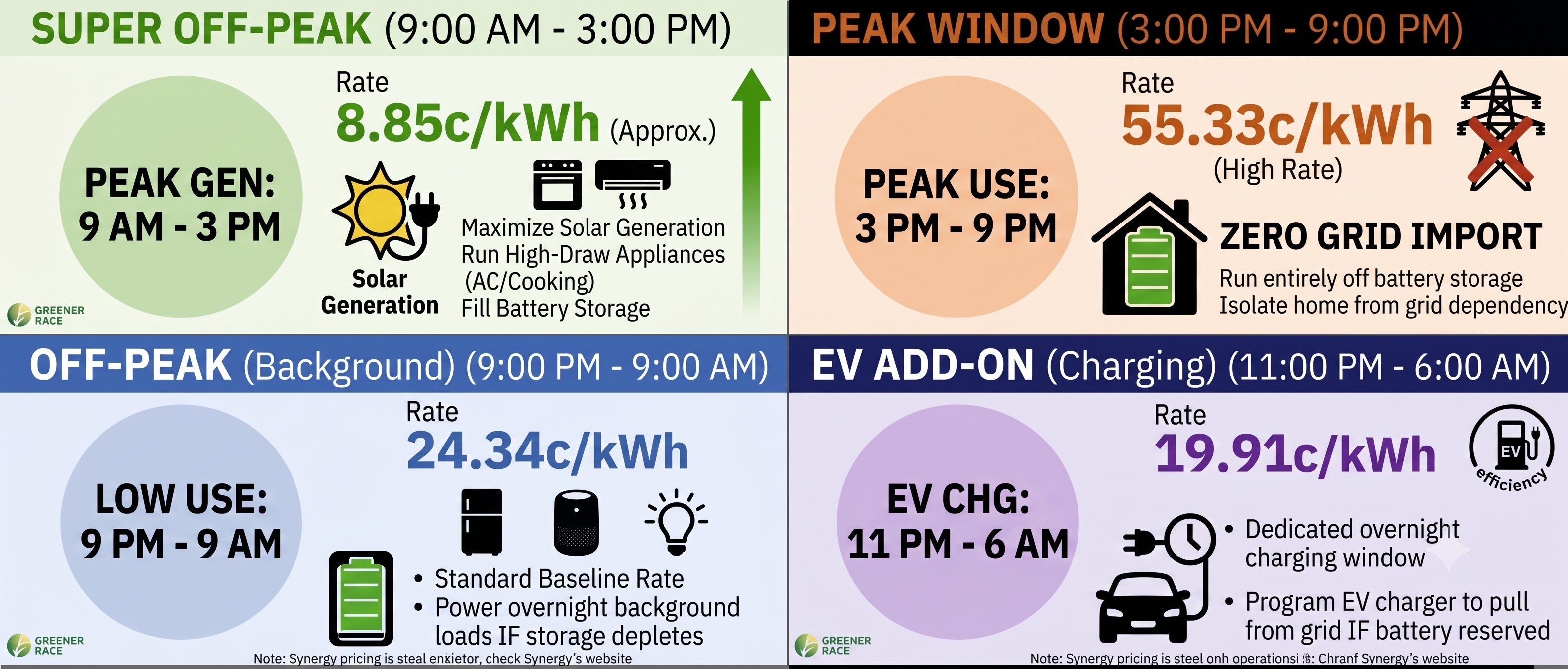
| Tariff Window | Time Frame | 2026 Synergy Rate (Approx.) | Hardware Operational Objective |
|---|---|---|---|
| Super Off-Peak | 9:00 AM to 3:00 PM | 8.85c/kWh | Maximize solar generation, run high-draw appliances, fill battery. |
| Peak Window | 3:00 PM to 9:00 PM | 55.33c/kWh | Zero grid import. Run the property entirely off battery storage. |
| Off-Peak | 9:00 PM to 9:00 AM | 24.34c/kWh | Standard baseline rate for overnight background loads if storage depletes. |
| EV Add-On | 11:00 PM to 6:00 AM | 19.91c/kWh | Low-cost dedicated charging window for registered electric vehicles. |
Load Shifting Strategy: Navigating the 2026 Time-of-Use Windows
Optimizing your power draw through automated load shifting yields dramatic cost reductions. During the Super Off-Peak window (9:00 AM to 3:00 PM), electricity costs next to nothing at 8.85c/kWh. To put that metric into a real-world outcome: completely filling a massive 15kWh home battery from the grid during this window would cost you just $1.32. The system's primary objective during this morning window is to power the home, pre-cool the property via the HVAC system, and aggressively top up the battery storage to 100% using clean solar energy.
When the clock strikes 3:00 PM, grid electricity prices skyrocket by over 500% to a brutal 55.33c/kWh. This is the danger zone. If you arrive home, fire up a 3kW oven, and crank a 5kW ducted air conditioner without battery backup, that combined 8kW power draw will cost you over $4.40 an hour just to keep the house running.
Your hardware automation must immediately transition the property into full island mode, running the entire home exclusively off the battery to shield you from these punishing rates. A properly sized home battery is a non-negotiable requirement to survive this afternoon peak.
During the winter months when local solar generation drops significantly, we pivot our strategy to winter grid arbitrage. Instead of relying solely on the sun, we program the system to buy that cheap 8.85c/kWh power directly from the grid during the midday window to artificially top up the battery tank. This stored energy is then discharged during the afternoon peak, protecting you from the 55.33c/kWh rate even when it's pouring rain outside.